
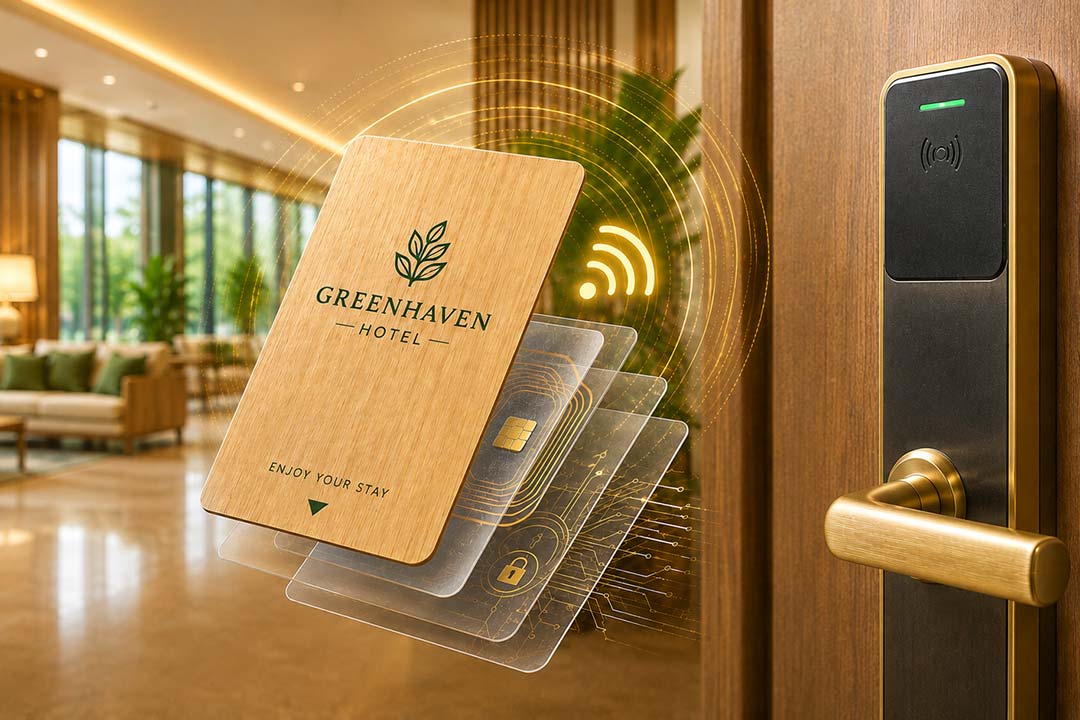
There was a time when getting into a hotel room involved a piece of metal, a little patience and, occasionally, an awkward conversation with reception. Then came the hotel key card. With it came a quiet revolution in the way hotels manage access.
Today, RFID technology is so familiar that most guests barely notice it. Hold a card near the reader, hear the reassuring click, and the door opens. But behind that simple interaction lies several decades of technological development, and RFID continues to evolve.
From Magnetic Stripes to Contactless Access
Early generations of electronic hotel access relied heavily on magnetic-stripe cards. These represented a major improvement over traditional keys: cards could be issued, cancelled and reprogrammed electronically. But magnetic stripes had limitations. They involved physical contact with the reader, were susceptible to wear and could become unreliable over time.
RFID changed that. Radio Frequency Identification allows information to be exchanged wirelessly between the card and the reader. There is no magnetic stripe to swipe and no physical contact required. Modern hotel access systems commonly use high-frequency RFID technologies, including 13.56 MHz platforms and a range of contactless smart-card technologies.
RFID Is More Than "Just a Chip"
It is tempting to think of an RFID hotel key card as a piece of plastic with a chip inside, but it is rather more complicated than that. Different cards can contain different chips, memory structures, security features and encoding configurations.
Technologies within the MIFARE family, for example, have evolved from earlier implementations towards more sophisticated platforms offering stronger security. This matters because 13.56 MHz does not automatically mean compatibility. Two cards can operate at the same frequency while using different technologies or security configurations. In other words, just because two cards speak "RFID" doesn't necessarily mean they speak the same language. This is why the hotel's existing locking system remains the starting point when specifying replacement or new key cards.
From Opening Doors to Managing Access
RFID also changed what a hotel could do with a key card. The card could provide access not only to a guest room, but potentially to elevators, fitness facilities, lounges, parking areas and other controlled spaces. Access rights could be associated with the guest's stay and adjusted according to the hotel's requirements.
The key card therefore became more than a door opener: it became a credential—a physical object carrying permission to access particular parts of the property. That is why choosing the correct card technology is an operational decision, not simply a printing decision.
The Security Story Has Evolved Too
As RFID technology developed, so did the security mechanisms built into contactless credentials. Earlier generations of smart-card technology provided useful improvements over magnetic-stripe systems, while newer platforms can incorporate more sophisticated authentication and encryption.
Guests don't need to understand any of this. They simply expect the card to work. Behind that expectation, however, the access system is determining whether the credential is valid and whether it has the appropriate permissions. Modern RFID therefore represents an ongoing balance between security, convenience and usability.
And Then RFID Met the Smartphone
One of the more interesting developments is that RFID also helped bridge physical credentials and digital experiences. NFC—Near Field Communication—is closely related to high-frequency RFID and is incorporated into smartphones today. This has opened possibilities for mobile credentials and other contactless interactions. Hotels can increasingly offer access through smartphones, digital wallets and other contactless credentials, depending on their locking system and technology platform.
But this doesn't make the physical RFID card obsolete. In practice, hospitality access is becoming increasingly hybrid. A hotel may offer mobile access to guests who want it while continuing to issue physical cards to others.
There are also some very practical reasons for doing so: phones run out of battery; apps occasionally misbehave networks fail; guests forget things. And some people simply don't want their smartphone to be their room key.
The physical card remains remarkably good at its job.
RFID Has Created New Guest Touchpoints
The RFID/NFC-enabled card doesn't necessarily stop functioning once the guest reaches the room. Some hospitality applications allow RFID or NFC-enabled cards to interact with smartphones and connect guests to additional digital services, such as hotel information or Wi-Fi. This illustrates how RFID has evolved.
The question has moved from: "Does this card open the door?" towards: "What else can this credential do?"
For hotels, this creates opportunities to connect physical and digital elements of the guest journey without abandoning the physical card.
What Does This Mean When Choosing Hotel Key Cards?
For hotel operators, the evolution of RFID makes one principle particularly important: Specify the technology before specifying the card. The hotel's locking system, encoder and required credential technology need to be understood before cards are ordered.
Once compatibility has been established, the hotel can consider the other elements that matter:
- Branding and design
- Material selection
- Sustainability
- Security requirements
- Durability
- Cost
- Local availability and support
This is where the card becomes interesting again. The technology may be sophisticated, but the finished product still sits in the guest's hand. It can be branded, sustainable, beautifully designed. And it can remain a simple, dependable way of getting into a hotel room.
The Evolution Isn't Finished
RFID has taken hospitality access a considerable distance from magnetic stripes and mechanical keys. Security technologies will continue to develop. Mobile credentials will become more widespread. Digital wallets, wearables and other contactless access methods will continue to emerge.
At the same time, physical RFID cards will remain an important part of the access landscape because they offer something technology sometimes struggles to provide - simplicity.
No battery. No app. No login. No notification asking you to update something while you're standing outside your room with luggage in both hands… Just a card that works.
Perhaps that is the most useful lesson from the evolution of RFID in hospitality. Technology doesn't always replace what came before. Sometimes it simply makes it better.
At GuestLock, we believe the hotel key card can be both technologically sophisticated and beautifully simple, combining compatibility, functionality, sustainability and branding within a single guest touchpoint.