
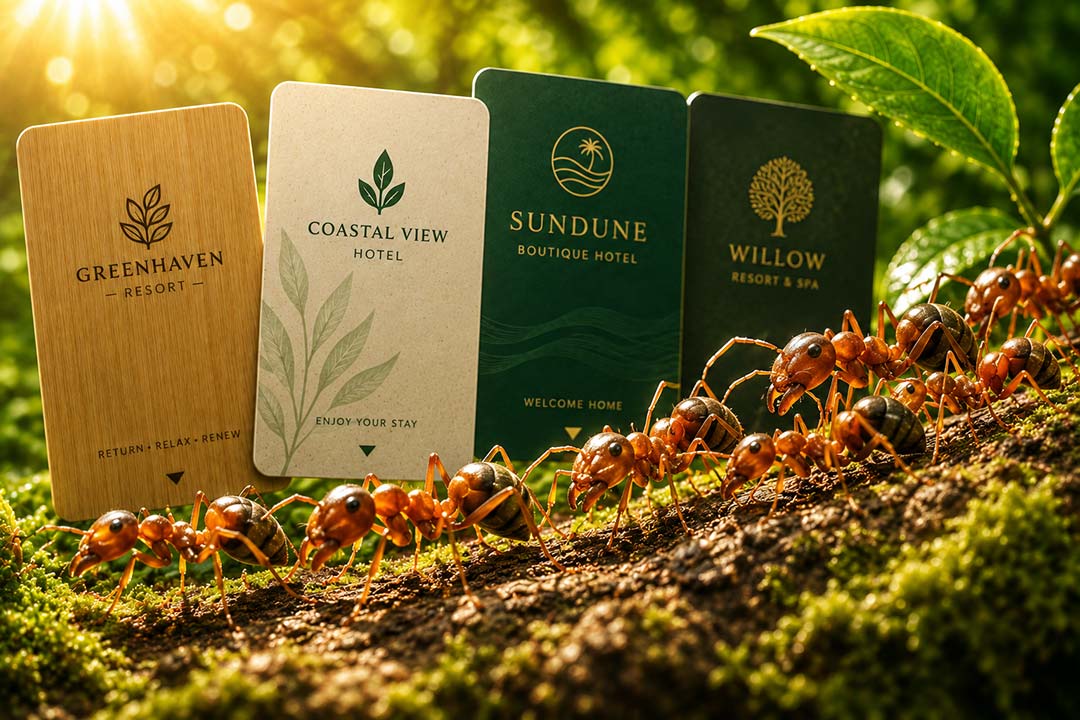
Have you ever watched a trail of ants working together?
One ant, on its own, is remarkably small. Yet together, thousands of ants can build a nest of extraordinary complexity or move an object many times their collective size.
There is something rather interesting about that when we think about sustainability. We tend to look for the big solution: solar energy, water conservation, eliminating single-use plastics, smarter heating and cooling systems and large-scale recycling programmes.
These initiatives are important, but sustainability is not only about the big things. Sometimes it is about looking at the thousands of small things a hotel does every day and asking a simple question:
What are we using that could be made better?
Perhaps, like the ants, meaningful change comes not from one extraordinary effort, but from many small ones working together.
An Overlooked Everyday Essential
One such example is the hotel key card.
Every guest receives one. Every guest uses one. For many hotels, thousands are issued every year. Yet despite being one of the most widely distributed physical items in hospitality, the environmental impact of hotel key cards is rarely considered.
Traditionally, most key cards have been manufactured from virgin PVC—a durable and cost-effective material produced from fossil-fuel-derived resources. PVC has served the hospitality industry well for decades. But as global demand for raw materials continues to grow, it raises an increasingly relevant question: Should products designed for everyday use continue to rely on materials that cannot naturally be replenished?
The question is not about abandoning what works. It is about remaining open to better alternatives as they become available.
The Shift Towards Renewable Resources
One of the defining challenges of the twenty-first century is learning to meet growing demand while placing less pressure on finite natural resources. That shift is already driving innovation across countless industries. Packaging is becoming more recyclable, construction materials are evolving towards lower-carbon alternatives, and consumer products are increasingly being manufactured using recycled or renewable resources.
Hospitality is following the same path.
Hotels are beginning to consider the environmental impact of what they purchase more broadly. Not simply in terms of energy consumption, but also the origin, lifespan and end-of-life management of products used throughout the operation. This represents an important change in perspective because sustainability is rarely determined by a single decision. It is the cumulative effect of hundreds of purchasing choices made throughout an organisation.
And this is where our ants come back into the picture.
One ant doesn't build the nest.
One small purchasing decision doesn't make a hotel sustainable.
But thousands of small decisions, made consistently and thoughtfully, can begin to change the shape of the whole.
Small Choices Create Meaningful Change
No hotel becomes sustainable overnight. Progress is achieved through continual improvement. Replacing conventional lighting with LED technology, installing low-flow water fixtures, reducing food waste, choosing refillable guest amenities and selecting recycled or renewable materials where practical all contribute to a much larger picture.
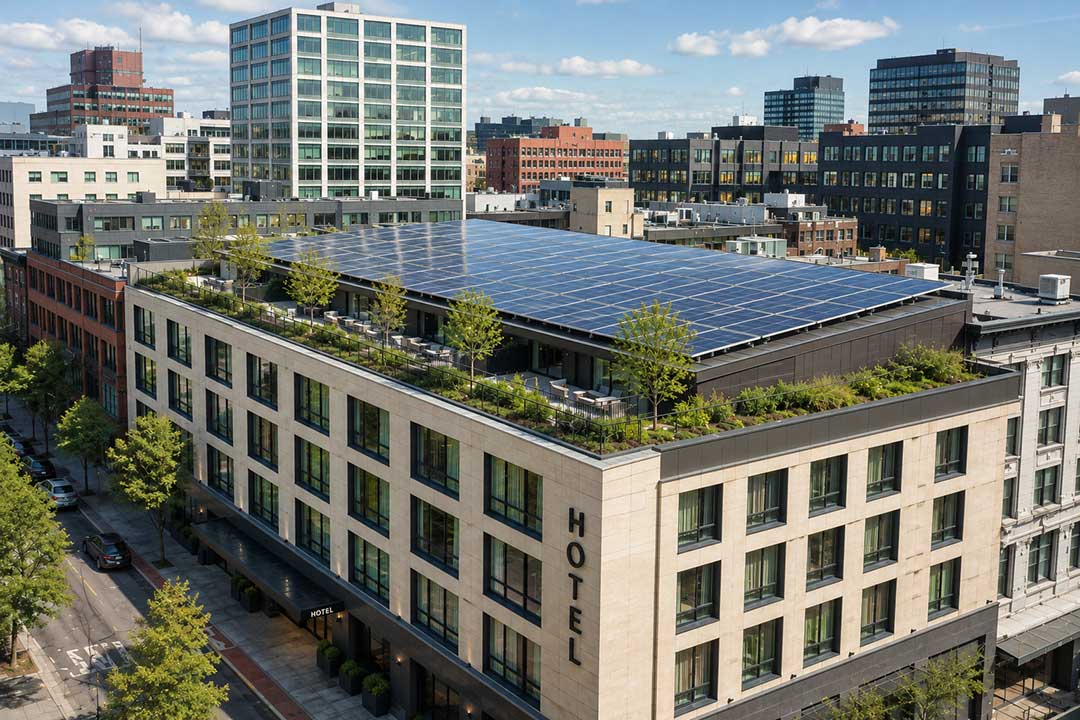
The hotel key card may appear insignificant beside major infrastructure investments like solar panels, but it represents an interesting example of how even the smallest guest touchpoints can evolve.
Today, alternatives such as recycled PVC, plant-based composite materials, bamboo and responsibly sourced wood demonstrate that premium presentation, durability and environmental responsibility do not necessarily have to be mutually exclusive. These innovations allow hotels to reduce their reliance on virgin raw materials while maintaining the quality and reliability expected by both operators and guests.
The key card will not transform a hotel's environmental performance on its own. But then, neither does one LED light bulb. The point is not the size of the individual decision. It is what happens when many decisions begin moving in the same direction.
Sustainability Is Also a Brand Experience
Modern travellers increasingly notice the choices hotels make.
They notice refillable bathroom amenities and locally sourced products. They notice energy-saving initiatives and, increasingly, the materials that surround them throughout their stay. The hotel key card is often the first branded item a guest holds. It accompanies them throughout their stay, travels in and out of the room countless times and may even become a small keepsake taken home after departure.
That makes it more than an operational item. It can become a subtle expression of a property's values.
When sustainable materials are thoughtfully incorporated into everyday guest touchpoints, they become tangible evidence that sustainability is being considered not only in the hotel's infrastructure, but also in the details of the guest experience.
Perhaps that is where sustainability becomes most convincing: when it doesn't need to announce itself.
It is simply reflected in the choices a hotel makes.
Looking Beyond Cost
Purchasing decisions have traditionally been driven by two questions: Does it perform? What does it cost?
Increasingly, a third question is becoming equally important: What impact does it have?
Forward-thinking hospitality businesses are recognising that procurement is no longer simply about acquiring products. It is about making decisions that align with operational goals, brand values and long-term environmental responsibility. This doesn't mean replacing everything overnight.
It means remaining open to better alternatives and asking whether the conventional choice is still necessarily the only choice.
Every Touchpoint Matters
Hospitality has always been an industry built on details. The warmth of a welcome, the comfort of a room, the quality of the linen, the presentation of a meal and the simplicity of accessing a guest room may seem like separate things, but collectively they define the guest experience.
The same philosophy applies to sustainability.
Meaningful environmental progress is rarely achieved through one revolutionary product or one ambitious initiative. It is built through hundreds of thoughtful decisions that gradually reshape the way a business operates.
Perhaps the hotel key card is one of those decisions. Not because it will transform the world on its own, but because it reminds us that sustainability often begins by reconsidering the ordinary.
And perhaps that is the lesson of the ants.
They don't build their remarkable structures by waiting for one enormous contribution. Each one simply does its small part, again and again, until something much larger exists than any individual ant could ever have created.
Hotels can do something similar. One decision at a time. One product at a time. One touchpoint at a time.
Eventually, those small choices begin to look rather less small. Hotel key cards, reimagined.